Tuesday, November 17, 2009

Würzburg & Rothenberg

Würzburg was one of the most severly damaged large cities in Germany during WWII, with approximately 85% of the city in ruins. Fortunately, the Archbishop's Palace, now designated a UNESCO World Heritage Site, was spared even though fire swept through the structure. The artwork, tapestries, antiques and furnishings had been removed and stored in a safe location in anticipation of an attack. The baroque building and gardens have been fully restored with the original furnishings and is open for tours.
Statues on the courtyard fountain honor the arts depicting a poet, musician and sculpturer.
A fortification wall surrounds the well preserved old town of Rothenburg. Althought there are some concessions to the tourist trade, the building still reflect its medieval history and this was one of our favorite visual-appealing stops so far.


Restoration work extends to all facets of the city, including the streets. The cobblestones in the many walkways have been replaced with smoother stones to making navigating the gift shops more pleasurable...
No self respecting medieval town would pass up the opportunity to showcase the torture devices from its past. The "rack" shown below would stretch the unfortunate victim, dislocating joints until a confession was extracted. Often a single confession was insufficient for conviction and up to three people would be subjected to torture until enough evidence was received to convict the "guilty" party.

Monday, November 16, 2009

Bamberg, Germany

Bamberg is a UNESCO world heritage site because of its authentic medieval appearance and abundance of Baroque partician houses. The cathedral of Saint Peter and Saint George was finished in 1012, destroyed by fire and rebuilt in 1081. Hope you don't tire of seeing churches and castles - as our tour guide so aptly put it, we are on the ABC tour (Another Beautiful Cathedral/Another Beautiful Castle).
Tomb of Emperor Henry II and his wife, Eleanaor of Aquitaine.
To give a better sense of scale to these majestic cathedrals - this is a life size sculpture of the Bamberg Horseman, sculpted around 1200.
One of the several side alters.
Large sections of Bamberg date to the Medieval times. The sagging roof lines make it feel like if one building was removed, the whole row would fall down.
This is a view of the Old Town Hall, built in the middle of the Regnitz River and only accessible by bridge.
New art accents the older architecture throughout the city.

Sunday, November 15, 2009

Nuremberg, Germany

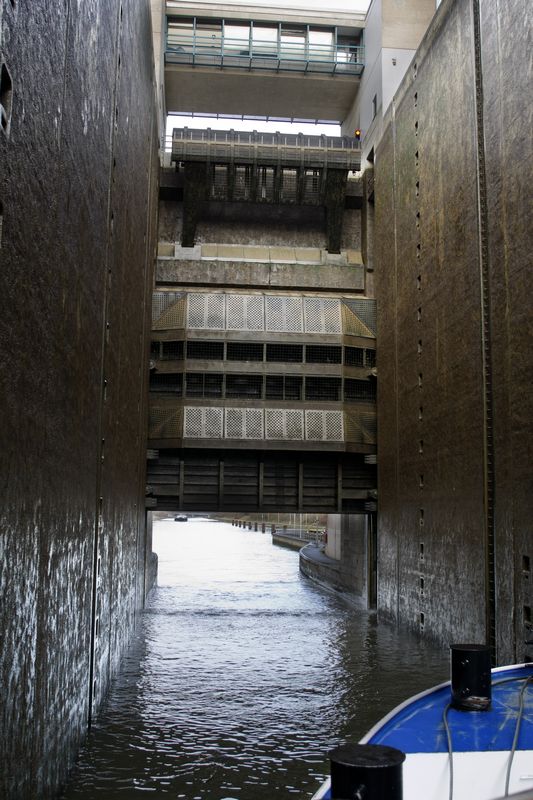
Next time we need to bring our RV! Motorhomes are a rare sight in this area of narrow streets and high gasoline prices.Shortly after we left Regensburg, we entered the Rhine-Main-Danube waterway, a 106 mile canal built to connect the Danube and Main rivers. This engineering marvel took 32 years to complete and includes 16 locks, 7 aquaducts and connects 15 European countries. A path runs the length of the canal and is extensively used by bicyclists, walkers and runners.
Three of the locks are approximately 85 feet high each - as high as an 8 story building.Nuremberg is best known as the site of the trials after WWII where many Nazi leaders were tried for war crimes, but it was also home of the Nazi congress - a meeting drawing tens of thousands held every September allowing Hitler to show his supporters the strength of the Nazi party. Several of the structures build to support this event still exist. The massive grandstands at Zepplin Field accommodated the huge crowds that came to view the various Nazi groups. Hitler wanted his structures to be massive and strong to symbolize the strength of his Nazi party. Several of these structures still exist and are used today for activities opposite their original intentions -- for instance, one houses a center dedicated to helping oppressed peoples and another houses a museum showcasing the atrocities commited by the Nazi party with a learning center to promote tolerance and understanding.The Documentation Center, housed in the original Nazi Congress Hall shows pictures and films narrated via audio guides in several languages.

As tours generally go, we didn't have time to look at and listen to every single display, but our guide was exceptionally knowledgeable in taking us to Hitler's various venues and comparing pix of what it looked like in the 30's to what is there now. There is also a portion of the center that focuses on education of the youth to prevent racism, etc. so that history will never repeat itself. Pretty incredible!

Saturday, November 14, 2009

Regensburg, Germany

Walhalla temple is located on a hillside above the Danube River just east of Regensberg. Built between 1830 and 1842, it houses 65 placques and 130 busts of "famous personalities in German history--politicians, soverigns, scientists and artists", covering 2000 years of history. Sadly we were only able to view this neo-classical building from afar... Cruising is convenient but you realize how much you miss by not being able to explore the region at your own pace.Regensburg dates from the middle ages and remnants of the city's walls and former architecture are still visible. Being so far south and not having any strategic targets, it is one of the few German cities to avoid bombing during WWII. However time has taken its toll on the older structures and in the 50's many buildings were "pulled down" to avoid having them collapse on their own. A period of restoration followed and many structures were rebuilt using the original materials. Pieces were saved from those that couldn't be rebuilt and incorporated into the new building built on the site. Below is an example of a portion of the original wall that surrounded and protected the city, now incorporated into new buildings. Also note the lower windows on the white structure -- these were salvaged from the original medieval building and incorporated into the reconstruction design, in the approximate location that they originally occupied.
This 2000-year-old arch dates back to the times when this area was part of the Roman Empire.
Saint Peter's cathedral is another fine example of Gothic architecture from the 13th century. These majestic churches are in need of constant renovation and Germany imposes an 8% church tax to help fund these operations. Invidivuals declare their religious affiliation on their tax forms and the money is allocated accordingly. Historically, entire towns or regions belong to one faith, according to the local ruler's choice. Country-wide, thirty-five percent of the population of Germany is Roman Catholic, thirty-six percent Protestant (mostly Lutheran) and a small percentage is Jewish. Individuals who declare no religous affiliation can avoid the 8% surtax and this has hurt the restoration efforts in recent years, particularly during the current economic times.Love the datails...A person can get terribly thirsty walking around a new city. Many of the brewries are owned by the church (note the Pope's picture on the wall in the background). This one is also located in a hospital, so naturally we had to patronize it. The local beers are only available in the city where they are brewed as the Germans love their beer and there is never any left over for export. When you order a beer, the norm is a .5 liter glass, so if you want less (.25 liter) you must specify "ein klein" (small) beer. (Why would a person want less?)Regensburg is also home to Europe's oldest bridge, completed in 1146. Now only pedestrian and bicycle traffic is allowed to cross and ships are forbidden to go underneath. When the allied troops approached the bridge during WWII, the 1st and 10th pillars were blown up to impede the advance. As the Allied Forces approached from the south, the Nazis escaped in the opposite direction. The mayor came out to the bridge and told the US troops that the Nazis had retreated and the Americans were welcome to come into the city, thus saving this historic city from attack.The cathedral of St. Peter, built in the 13th century gothic style. A new "hanging" pipe organ was recently installed at a cost of over 2.5 million euro. The installation only required the drilling of four 5" holes in the ceiling. Christmas decorations are starting to go up in the shopping district.

Friday, November 13, 2009

Passau, Germany

Just across the border into Germany, we docked at Passau, known as the city of three rivers, where the Inn and Ilz rivers join the Danube. The 2000-year-old old town is a mixture of Baroque and Gothic architecture, due in part to a major fire that destroyed much of the earlier Gothic buildings. The weather cooperated again and we were treated to an overcast, cool and dry day.
Saint Stephens Cathedral houses Europe’s largest pipe organ with 17,774 pipes. Liszt wrote his Hungarian Coronation Mass for this cathedral in 1857.The massive pipe organ actually consists of five individual pipe organs that, a few years back, were all wired to one central console allowing them to be played together or individually as desired. Our guide told us that this project was done in conjunction with a major renovation and required nearly 90 miles of wiring to accomplish, all completely hidden from view. Because of the placement of the pipes throughout the cathedral, the sound eminates from front, rear and the center of the ceiling providing a unique musical experience. Although organ concerts are performed throughout the year, sadly none was scheduled for the day we were there.

I love the narrow streets and architectual details in the older sections of European cities, so please indulge me if you see lots of these pictures.


Numerous cafes, pubs and bars line the waterfront. Passau brews several local beers but none are exported as the local population and tourists consume all they produce. Like good tourists, we did our part.
Another great side street. The area is so visually rich with cobblestone streets and, in this case, baroque architectre.