

 One hightlight of Mainz is the Gutenberg Museum. Johnann Gutenberg, inventor of the printing press was born here and a museum has been erected highlighting his inventions and the history of printing. Several copies of the Gutenberg Bible are on display in a highly protected glass case inside a vault with incredibly thick doors. Pictures are only allowed in certain areas and our schedule did not afford us the time to leisurly look at all the exhibits. A cruise shows you a sampling and leaves you with a desire to return and spend more time. Certainly this cruise is no exception - we've seen several cities that beckon us to to return.
  Christmas decorations are becomming more and more prominet as we approach the holiday season. In another week the Christmas markets will begin to open. We'd love to return and experience the the sights, sounds and smells during this festive time.
 In the center of Mainz stands the Romanesque Cathedral of Saints Martin and Stephen. Construction started in 975 and was not completed until the 13th century. I guess we shouldn't complain when that annoying freeway project takes a year or two to complete...
 The cathedral contains numerous lavishly decorated tombs, belonging to prominent bishops.

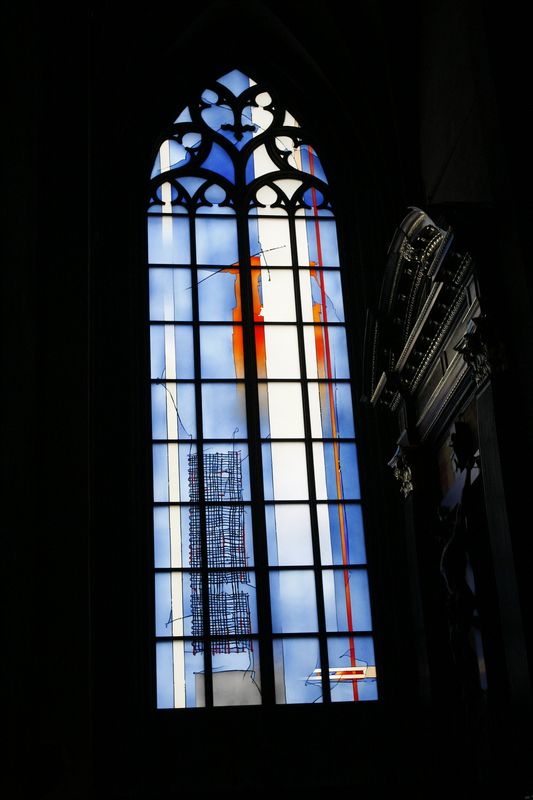
 Some of the original stained glass windows were broken during WWII and replacements were designed by Chagall, giving the cathedral a unique blend of old and new art.
 The trees certainly grow big leaves here!
 Rüdesheim, a World Heritage Site, is a winemaking town in the Rhine gorge. It is also home to the Siegfried's Mechanisches Musikkabinett, a museum dedicated to mechanical self-playing musical devices, from very large units weighing tons to tiny windup music boxes with even tinier mechanical chirping birds. Exhibits cover instruments spanning four centuries. The entire collection has been meticulously restored and several of the more spectatular units are played for you during the guided tour. Our guide was the son of the founder of the museum and is now one of the principal restorers so, as you can imagine, was very knowledgeable of the mechanisms and explained to us how some of the units came to them in pieces and how they restored or rebuilt them. Definitely worth a visit if you are in the area.


