Tuesday, September 21, 2010

Pennsylvania

It's a bit too early for the fall colors so we took advantage of the time to do a little exploring around Pennsylvania.

There's something about very old or abandoned building that is intriguing.

A drive through the Amish country afforded us the opportunity to view their traditional farming methods.

Friday, September 17, 2010

Entry into New York harbor

We entered New York harbor before sunrise and were greeted with a spectacular view of the waking city.

The Statue of Liberty welcomed us home as the city came to life.

Tuesday, September 14, 2010

St Johns, Newfoundland

We arrived in St Johns before dawn Tuesday morning and were already docked by the time we got up. Looking out our balcony we were surprised to see the narrow channel that the ship had to negotiate to get dockside.

Going ashore we realized how big the ship really was when we saw how it dwarfed the buildings along the harbor.

I'm always a sucker for street art.

Of course, there's a statue of a Newfoundland here in St Johns. This one is about 1.5 times life-size.

Betty and I opted to hike around the city rather than going with a tour group. We climbed to the top of Signal hill where we could see the lighthouse at the entrance of the bay.

Atop signal hill sits Cabot Tower. This sign made it perfectly clear exactly where we were.

View of the harbor and our ship from atop Signal Hill.

Cabot Tower was built in 1897. In 1901 Marconi received the first trans-Atlantic wireless message from a location near this tower. The message consisted of the letter "S" sent repeatedly in Morse Code from Cornwall, England.

From Signal Hill we hiked up to Ladies Lookout, where ladies would come to watch for their sailor's ships coming home or possibly going out to sea.

The trail down the backside of Ladies Lookout.

A small fishing harbor just outside St. Johns.

In case you are ever in the market for a bicycle built for 30.

Quidi Vidi Lake is a large expanse of water in St. Johns that is a popular site for rowing competition.

More street art off Water Street in downtown St. Johns.

The old fort at the mouth of the harbor going into St. Johns.

Saturday, September 11, 2010

Qaqortoq, Greenland

Qaqortoq is the most populous town in southern Greenland, with a population of 3,306. For comparrison, our ship held 3,100 passengers and 1,600 staff.

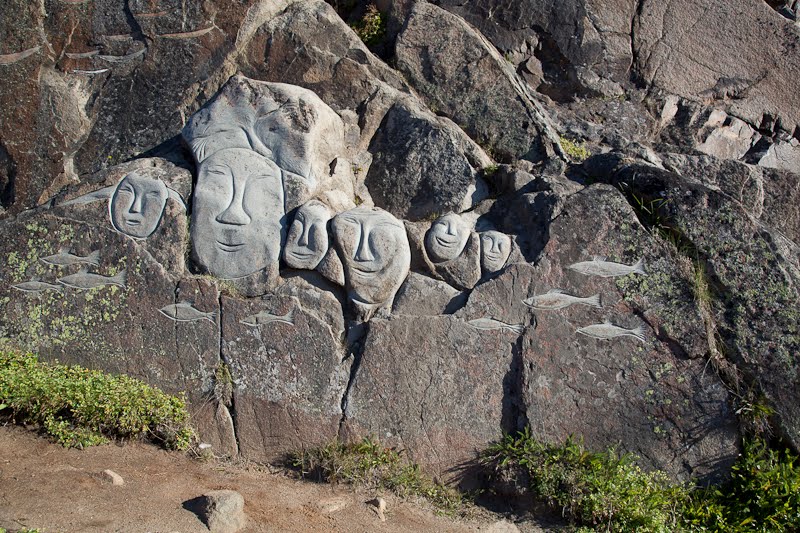
With an eye toward future development, the town created a sculpture park enlisting the help of 18 Nordic artists. Tourism is helping fund new development including a new harbor, a hydro-electric plant and airport facilities (currently they only have a heli-port, located adjacent to the hospital.) I'm sure the flavor of Qaqortoq will become more tourist-oriented as this happens, but today it still retains its original atmosphere with only one small gift shop set up for the tourists. A short walk away you are in the center of town mingling with locals.

These are just a few examples of the rock sculpture which can be found throughout the community.

This is one of only two fountains in the entire country of Greenland. Since much of the year is below freezing, it is probably somewhat of an rarity to see it operating. The weather was clear and beautiful the day we were there (somewhere in the mid to high 60's) and many locals were out walking around, pushing baby strollers or sitting in the town square.
I'm not sure if this guy is a fisherman or a butcher, but regardless he was butchering what appeared to be seals. Outside were maybe 6 tables set up for locals to sell their wares - kind of like a small local farmer's market selling everything from fresh fish to dead seagulls to dried fish to fresh produce, etc.

Ocean fishing is a dangerous profession in these icy-cold waters and this monument in the Frelserns Church remembers sailors lost in a 1959 shipwreck.
Qaqortoq houses a small museum featuring the work of local artists, items of historical significance and a brief history of the community.

Friday, September 10, 2010

Skovfjord and Bredefjord, Greenland

Since we were unable to dock in Iceland, we had an extra day at sea with which the captain treated us to a side trip into Skovfjord and Bredefjord ice fields.
We docked for a short time outside the small Greenlandic town of Narssaq. Too large to go ashore we stayed just long enough for everyone to enjoy the serene beauty of the area. A small tender was launched to gather a piece of glacial ice that would be used for an ice carving demonstration later in the day. Glacial ice is clear or blue in color and easier to carve than regular ice. Even this late in the year a special ice pilot had to accompany our ship through these waters where there were still packs of free floating ice. The captain said that during the spring thaw approximately 1.5 million pounds of polar ice float down the eastern shore of Greenland daily making navigation in this area quite treacherous. You could once determine a person's occupation by the color of his or her house or office -- red for retail trade, yellow for health care, green for engineering, etc. Even if not true today, the bright colors add to the beauty of the landscape. A local came out to greet us in the harbor.
Here you can see the difference in color of the glacial or polar ice (blue) and the normal winter ice which is white.
The white ice sheet in the background is the north polar ice cap.